
Table of Contents
- Early Life and Background
- College Football Career at Florida
- NFL Career with the New England Patriots
- Salary, Contracts, and Career Earnings
- Endorsements and Sponsorship Deals
- Legal Troubles and Financial Impact
- Net Worth at Peak vs. After Arrest
- Assets, Lifestyle, and Spending Habits
- Financial Losses and Missed Earnings Potential
- Legacy and Public Perception
- Conclusion
Aaron Hernandez was a prominent NFL star whose career and financial standing took a dramatic turn due to legal troubles. At his peak, many fans wondered about Aaron Hernandez net worth as he signed multi-million dollar contracts with the New England Patriots. However, his professional football career and salary earnings were quickly overshadowed by high-profile criminal trials, leading to a complex and tragic financial legacy.
Have you ever wondered how a top-tier athlete loses everything in an instant? It is a gripping tale of fame, contractual bonuses, and legal downfall. Transitioning from a superstar tight end to a defendant in a courtroom changed his estate value forever. This story serves as a stark reminder of how quickly wealth can vanish under pressure.
His financial assets and real estate holdings became central topics during his litigation. Although he earned millions on the gridiron, his liquid cash dwindled rapidly. Today, his legal history and bankruptcy status remain a cautionary tale for pro sports players regarding long-term stability.
Early Life and Background
Aaron Hernandez was born on November 6, 1989, in Bristol, Connecticut, into a family with deep ties to local athletics. His father, Dennis Hernandez, was a well-known figure in the community, and his brother, D.J. Hernandez, preceded him in the world of competitive football. From a young age, Aaron exhibited extraordinary physical gifts that set him apart on the gridiron. He attended Bristol Central High School, where he became a standout athlete, earning national recognition for his ability as a tight end and wide receiver.
However, his early years were also marked by personal tragedy and environmental challenges. The sudden death of his father when Aaron was just 16 years old is often cited by biographers as a pivotal moment that impacted his emotional stability. Despite these internal struggles, his performance on the field remained elite. By the time he was a senior, he was considered one of the top recruits in the country, eventually committing to the University of Florida to play under head coach Urban Meyer.
College Football Career at Florida
At the University of Florida, Hernandez’s talent reached new heights as he became a focal point of the Gators’ offense. Playing alongside stars like Tim Tebow, he contributed significantly to the team’s success, including a BCS National Championship victory in 2008. His ability to catch passes with the fluidity of a wide receiver while possessing the size of a traditional tight end made him a nightmare for opposing defenses in the Southeastern Conference (SEC).
In 2009, Hernandez won the John Mackey Award, which is given annually to the most outstanding tight end in college football. He was also named a First-team All-American. While his on-field production was undeniable, there were quiet concerns among NFL scouts regarding his off-field associations and maturity. These “character flags” eventually played a significant role in his professional draft stock, causing him to slide further down the board than his talent alone would suggest.
NFL Career with the New England Patriots
The New England Patriots selected Hernandez in the fourth round of the 2010 NFL Draft. This was seen as a massive “steal” for the organization, as his talent was clearly that of a first-round pick. Joining the Patriots allowed him to team up with Rob Gronkowski, creating a “two-tight end” offensive system that revolutionized NFL playbooks. Hernandez was versatile, often lining up in the backfield or as a slot receiver, making him a cornerstone of the Patriots’ high-powered offense led by Tom Brady.
During his three seasons in Foxborough, Hernandez was highly productive. He recorded 175 receptions for 1,956 yards and 18 touchdowns. He was a key part of the team that reached Super Bowl XLVI, where he even caught a touchdown pass. His speed and agility for his size were unprecedented at the time. By 2012, the Patriots viewed him as a long-term fixture of their dynasty, leading to one of the most lucrative contract extensions in the history of the position.
Salary, Contracts, and Career Earnings
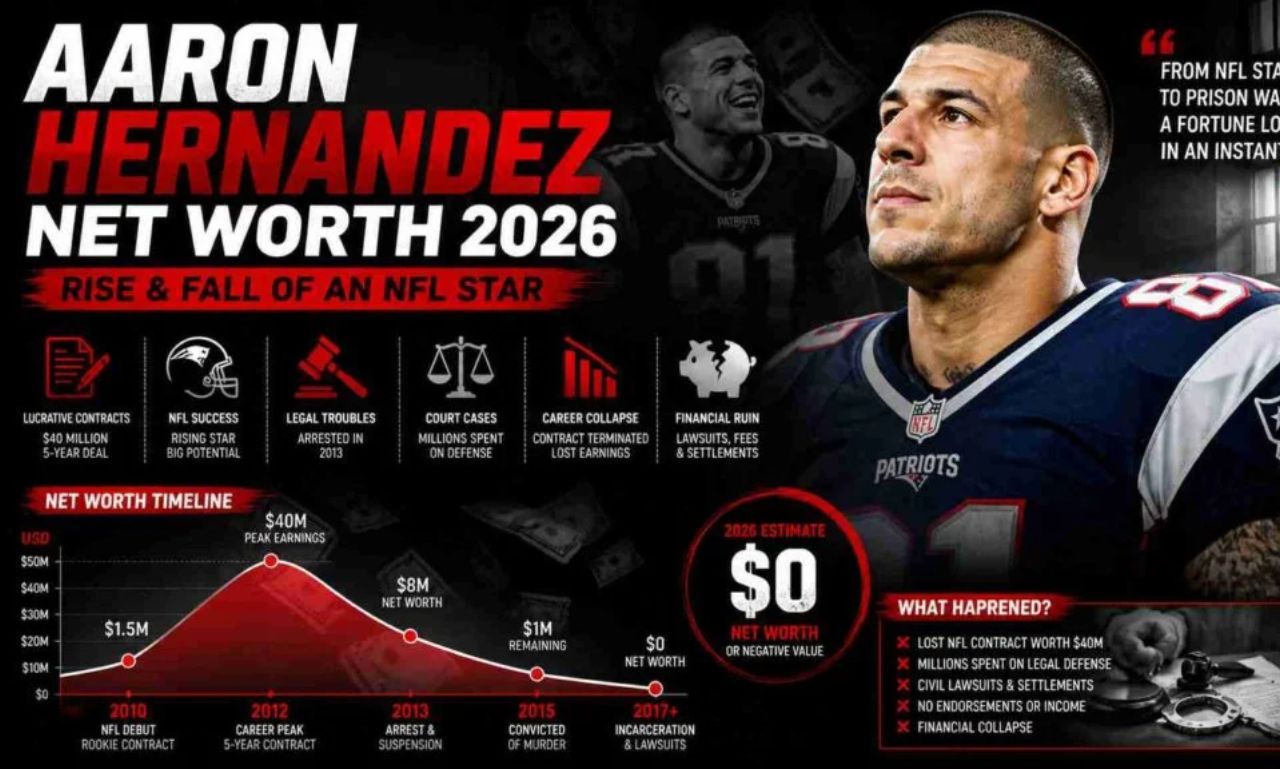
The financial peak for Hernandez came in August 2012 when he signed a five-year contract extension worth $40 million. This deal included a $12.5 million signing bonus, a staggering sum that was intended to be paid out over several years. This contract was supposed to elevate his financial standing to the top tier of NFL earners. Prior to this, he was playing on his rookie contract, which paid him a relatively modest base salary compared to his output on the field.
His total career earnings are estimated to be approximately $11 million to $13 million in actual cash received before his arrest. While the $40 million figure is often cited, the vast majority of that money was non-guaranteed and tied to future seasons he never played. The Patriots were quick to freeze payments and move for a “clawback” of his signing bonus once the legal proceedings began, illustrating how quickly a player’s salary earnings can vanish due to morality clauses.
Career Earnings Overview
To better understand the flow of money, the following table breaks down his estimated earnings by year:
| Year | Type of Income | Amount (Estimated) | Note |
| 2010 | Rookie Salary & Bonus | $650,000 | Paid |
| 2011 | Base Salary | $540,000 | Paid |
| 2012 | Signing Bonus & Salary | $9,500,000 | Major Payout |
| 2013 | Deferred Bonus | $3,250,000 | Disputed/Held |
| Total | Gross Earnings | $13,940,000 | Before Taxes/Fees |
The data shows that while he signed for forty million, the actual liquid wealth he touched was a fraction of that total.
Endorsements and Sponsorship Deals
At the height of his fame, Hernandez was a highly marketable figure. In April 2013, just months before his arrest, he signed a major endorsement deal with the global sportswear brand Puma. He was set to be the face of their new training line, a partnership that would have significantly boosted his off-field income. These types of deals are essential for athletes to build long-term wealth, as they often provide “passive” income compared to the physical toll of playing football.
In addition to Puma, he had local ties and smaller sponsorship arrangements that added to his annual revenue. However, all of these partnerships were terminated within hours of his name being linked to the Odin Lloyd investigation. The loss of these sponsorship deals represented a permanent end to his marketability, ensuring that his income would never recover from the blow dealt by his legal troubles.
Legal Troubles and Financial Impact
The arrest of Aaron Hernandez in June 2013 for the murder of Odin Lloyd was the catalyst for his total financial destruction. Legal fees for a high-profile murder trial are immense. Hernandez hired top-tier defense attorneys, including Michael Fee and later Jose Baez. These legal teams require massive retainers and involve costs for private investigators, forensic experts, and extensive travel. It is estimated that his defense costs across multiple trials reached several million dollars.
Beyond the criminal defense, the financial impact included civil lawsuits filed by the families of the victims. These wrongful death suits sought to seize whatever assets remained in his estate. By the time of his death in 2017, court records indicated that his estate was essentially bankrupt, with many of his assets either sold off to pay lawyers or held in escrow pending the outcome of civil litigation.
Net Worth at Peak vs. After Arrest
At his absolute peak in late 2012, Hernandez’s net worth was estimated to be around $8 million to $10 million in liquid and fixed assets. He had the $12.5 million bonus coming in, a luxury home, and a fleet of high-end vehicles. He was, by all accounts, a wealthy young man with the potential to reach a nine-figure net worth if his career had continued on its trajectory through 2026.
After his arrest, this figure plummeted almost instantly. With his NFL paychecks stopped and the Patriots suing to recover past bonuses, his liquidity dried up. By the time his mansion was sold and his legal bills were tallied, his net worth was essentially zero. The contrast between a multimillion-dollar superstar and an indigent defendant is one of the most stark examples of financial volatility in sports history.
Assets, Lifestyle, and Spending Habits
During his years of wealth, Hernandez lived a lifestyle consistent with an NFL superstar. His primary asset was a 7,100-square-foot mansion in North Attleboro, Massachusetts, which featured a pool, a home theater, and high-end finishes. He was also known for his interest in luxury vehicles, frequently driving customized SUVs and high-performance cars. This lifestyle required significant monthly cash flow for maintenance, taxes, and security.
However, beneath the surface of this luxurious lifestyle, his spending was also directed toward less publicized activities. Reports from his trials indicated high spending on travel, nightlife, and associations that ultimately contributed to his downfall. Unlike many athletes who invest in long-term portfolios, much of Hernandez’s wealth was tied up in tangible assets that were difficult to liquidate quickly when the legal bills began to mount.
Breakdown of Major Assets
To provide context on where his money was tied up, consider the following list:
- The North Attleboro Mansion: Valued at $1.3 million, later sold for roughly $1 million.
- Luxury Vehicles: Multiple high-end cars that were eventually repossessed or sold.
- NFL Pension: A protected asset that became a primary source of support for his daughter.
- Liquid Investments: Stock and bond portfolios that were liquidated to cover legal retainers.
Financial Losses and Missed Earnings Potential
If we project what Hernandez could have earned had he stayed in the league through 2026, the numbers are staggering. As a premier tight end, he likely would have signed at least one more major contract extension. Given the rising salary cap in the NFL, a player of his caliber would easily be earning $15 million to $20 million per year in today’s market.
When you factor in the missed career longevity and the loss of two decades of endorsement income, the total financial loss exceeds $100 million. This “missed potential” is a significant part of the tragedy from a purely financial perspective. His daughter, Avielle, was left with a trust fund supported by NFL pension payments and Social Security, rather than the massive inheritance a player of his status would typically provide.
Legacy and Public Perception
The legacy of Aaron Hernandez is a complicated mix of athletic brilliance and criminal tragedy. In the sports world, he is often remembered as a “what if” story—a player whose talent was generational but whose life was defined by violence. Public perception remains deeply divided; while some see him as a cold-blooded criminal, others point to his diagnosis of Stage 3 Chronic Traumatic Encephalopathy (CTE) as a contributing factor to his erratic behavior.
In 2026, his story is frequently used by the NFL and financial advisors as a cautionary tale for rookie players. It highlights the importance of surrounding oneself with the right people and understanding that wealth preservation is just as important as wealth creation. His name is now synonymous with the dangers of off-field misconduct and the fragility of professional success.
Conclusion
The story of aaron hernandez net worth is a narrative of extreme highs and devastating lows. From the $40 million contract extension in 2012 to an empty estate by 2017, his journey serves as a sobering reminder of how quickly life can change. While he earned millions on the field, his legal and personal choices ensured that very little of that wealth remained for his family. Today, his financial history is studied not for its success, but for the lessons it provides on the intersection of professional sports, the law, and personal responsibility.