
Table of Contents
- Start With Serving Size, Not the Whole Package
- Understand Percent Daily Value
- Pay Close Attention to Added Sugars
- Evaluate Fat Types, Not Just Total Fat
- Look Beyond Calories Alone
- Check Fiber and Protein for Satiety
- Read the Ingredient List Alongside the Label
- Watch for Misleading Front-of-Package Claims
- Turning Label-Reading Into a Quick Habit
- A Skill That Pays Off Every Time You Shop
Nutrition labels contain more useful information than most people realize, yet the format itself often discourages a close look—dense numbers, unfamiliar terms, percentages that seem to require a calculator to interpret meaningfully. Learning to read them efficiently turns a confusing wall of text into a genuinely useful shopping tool.
Start With Serving Size, Not the Whole Package
Every Number Depends on This Line
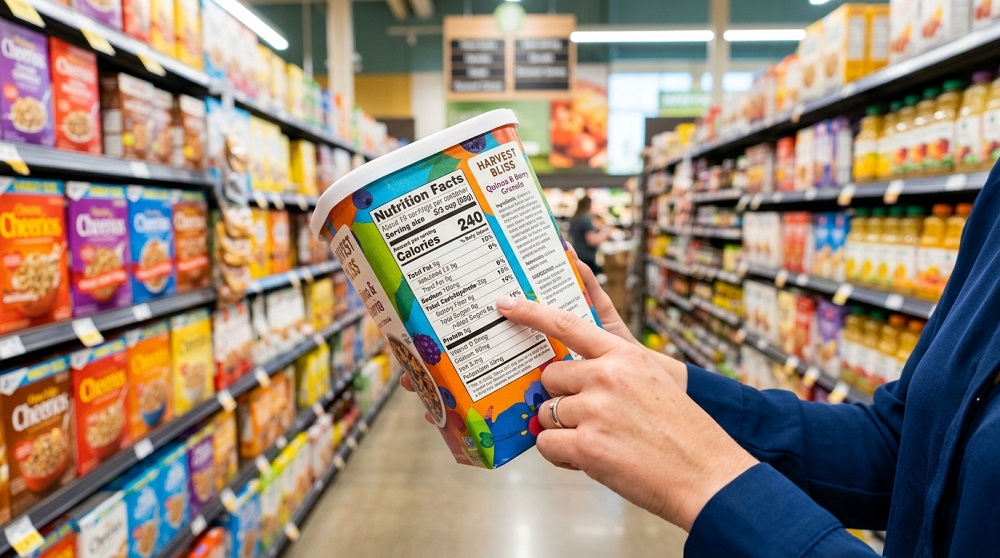
All the values listed on a nutrition label correspond to a single serving, not the entire package, which means a product that looks reasonably low in calories or sugar can be misleading if the actual serving size is much smaller than what someone would realistically eat in one sitting.
Compare Serving Size to Realistic Portions
Checking how the labeled serving size compares to how much you’d actually consume prevents the common mistake of assuming the listed numbers reflect an entire meal or snack, when they may represent only a fraction of it.
Understand Percent Daily Value
What the Percentage Actually Represents
The percent daily value shows how much a nutrient in one serving contributes toward a general daily recommendation based on a standard reference diet, offering a quick way to gauge whether a food is relatively high or low in a specific nutrient.
Use It as a Quick Comparison Tool
As a general guideline, five percent daily value or less is considered low for a nutrient, while twenty percent or more is considered high, a useful shortcut for quickly comparing similar products without needing to calculate exact amounts.
Pay Close Attention to Added Sugars
Distinguishing Added Sugar From Natural Sugar
Total sugar includes both naturally occurring sugar, like that in fruit or dairy, and added sugar introduced during processing, making the specific added sugar line far more useful for understanding a product’s actual nutritional impact.
Sugar Hides Under Many Different Names
Ingredient lists often disguise added sugar under various names—cane syrup, dextrose, concentrated fruit juice—making the added sugar line on the nutrition label a more reliable indicator than scanning ingredients for the word “sugar” alone.
Evaluate Fat Types, Not Just Total Fat
Not All Fats Affect Health Equally
Total fat alone doesn’t tell the full story, since unsaturated fats generally support health while saturated and trans fats are more strongly linked to negative cardiovascular effects, making the breakdown beneath total fat considerably more informative.
Watch Closely for Trans Fat
Even small amounts of trans fat, sometimes rounded down to zero grams per serving despite technically being present, warrant checking the ingredient list for partially hydrogenated oils, a reliable indicator of trans fat that labels don’t always fully disclose.
Look Beyond Calories Alone
Calories Don’t Reflect Nutritional Quality
Two products with identical calorie counts can differ enormously in nutritional value, making calories alone a poor standalone metric for evaluating whether a food genuinely supports health goals.
Consider Nutrient Density
Foods offering more vitamins, minerals, and fiber per calorie generally provide more nutritional value than calorie-equivalent options offering little beyond basic energy, a distinction calories alone can’t capture.
Check Fiber and Protein for Satiety
Fiber’s Role in Fullness and Digestion
Higher fiber content generally supports longer-lasting fullness and better digestive health, making it a nutrient worth actively seeking out rather than simply avoiding negative ones.
Protein Content Matters for Balanced Meals
Checking protein content helps evaluate whether a food will genuinely contribute to satiety and balanced nutrition, particularly relevant for snacks or meals intended to sustain energy over several hours.
Read the Ingredient List Alongside the Label
Order Reflects Quantity
Ingredients are listed in descending order by weight, meaning the first few ingredients make up the bulk of the product, offering useful insight beyond what the nutrition label’s numbers alone can show.
Shorter Ingredient Lists Aren’t Automatically Better
While heavily processed foods often have long, unfamiliar ingredient lists, list length alone isn’t a reliable quality indicator; what matters more is recognizing whether the ingredients present are genuinely nutritious or primarily fillers and additives.
Watch for Misleading Front-of-Package Claims
Marketing Claims Don’t Always Match the Label
Terms like “natural,” “light,” or “made with real fruit” are loosely regulated and don’t necessarily reflect what the nutrition label and ingredient list actually reveal, making it worth verifying front-of-package claims against the full label rather than trusting them at face value.
Comparing Similar Products Reveals the Real Differences
Placing two similar products side by side often reveals meaningful nutritional differences that marketing alone wouldn’t suggest, making direct label comparison one of the most reliable tools available while shopping.
Turning Label-Reading Into a Quick Habit
Focus on a Few Key Numbers, Not Everything at Once
Rather than analyzing every detail on every label, focusing consistently on a few priority metrics—added sugar, fiber, sodium—based on personal health goals makes the habit sustainable rather than overwhelming.
A Skill That Pays Off Every Time You Shop
Reading nutrition labels well doesn’t require nutritional expertise, just a working understanding of which numbers matter most and how to interpret them quickly. Once the habit becomes automatic, it turns grocery shopping from a guessing game into a far more informed, deliberate process.